Map Tiers: Behaviors & Examples
How Tier 1, Tier 2, and Tier 3 maps behave in practice. Tiers are not levels of “skill.”
They are depth-fields — lenses we may enter depending on what your story asks for.
THE BREAKDOWN
TIER 1 — ORIENTATION & DISCOVERY
“What is here?”
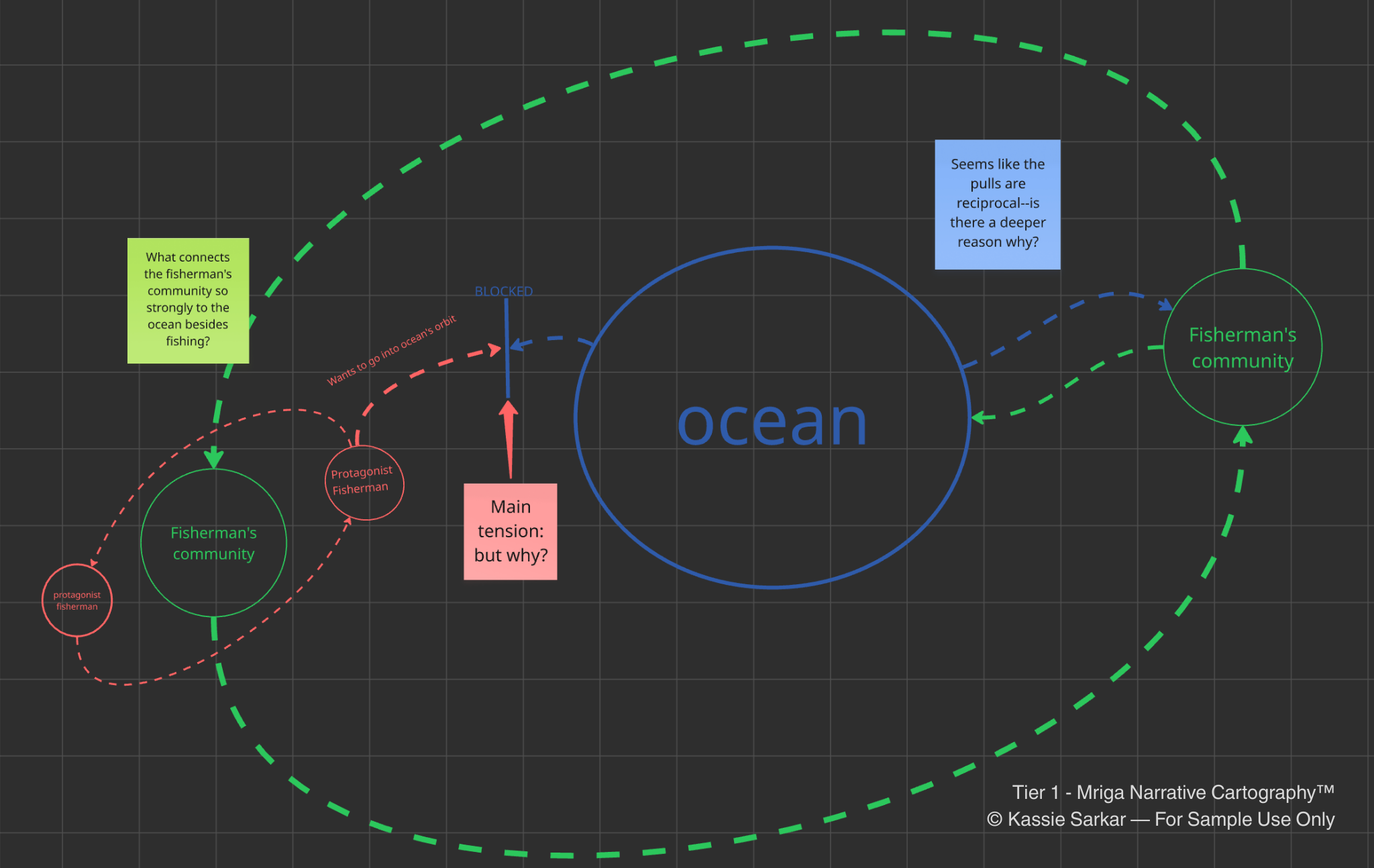
Tier 1 maps are light, gentle, and exploratory.
They identify the bodies in the story — the major forces, characters, or systems — and begin noticing their basic relationships.
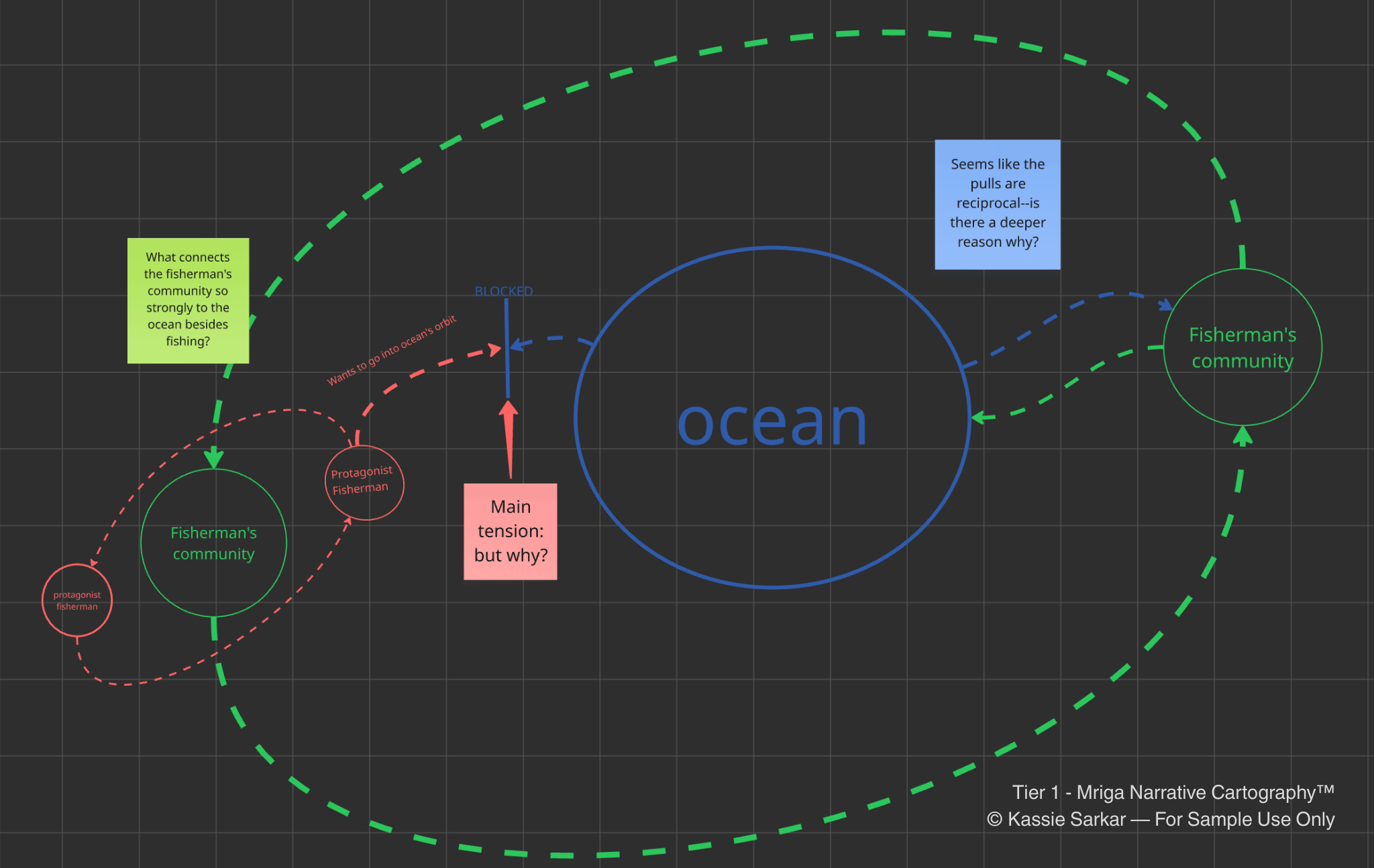
What Tier 1 might look like:
simple circles for characters or forces
light arrows showing general movement
broad questions such as:
“Who is orbiting whom?”
“Where is the emotional center?”
“What feels important but not yet understood?”
rough relational spacing (near/far, inward/outward)
curiosity-driven notes (“something here feels off”)
What Tier 1 does NOT do:
interpret deeply
analyze internal tensions
diagnose contradictions
label emotional gravity
Tier 1 is like walking the edges of a forest before entering.
TIER 2 — RELATIONAL ARCHITECTURE
“How do these bodies move together?”
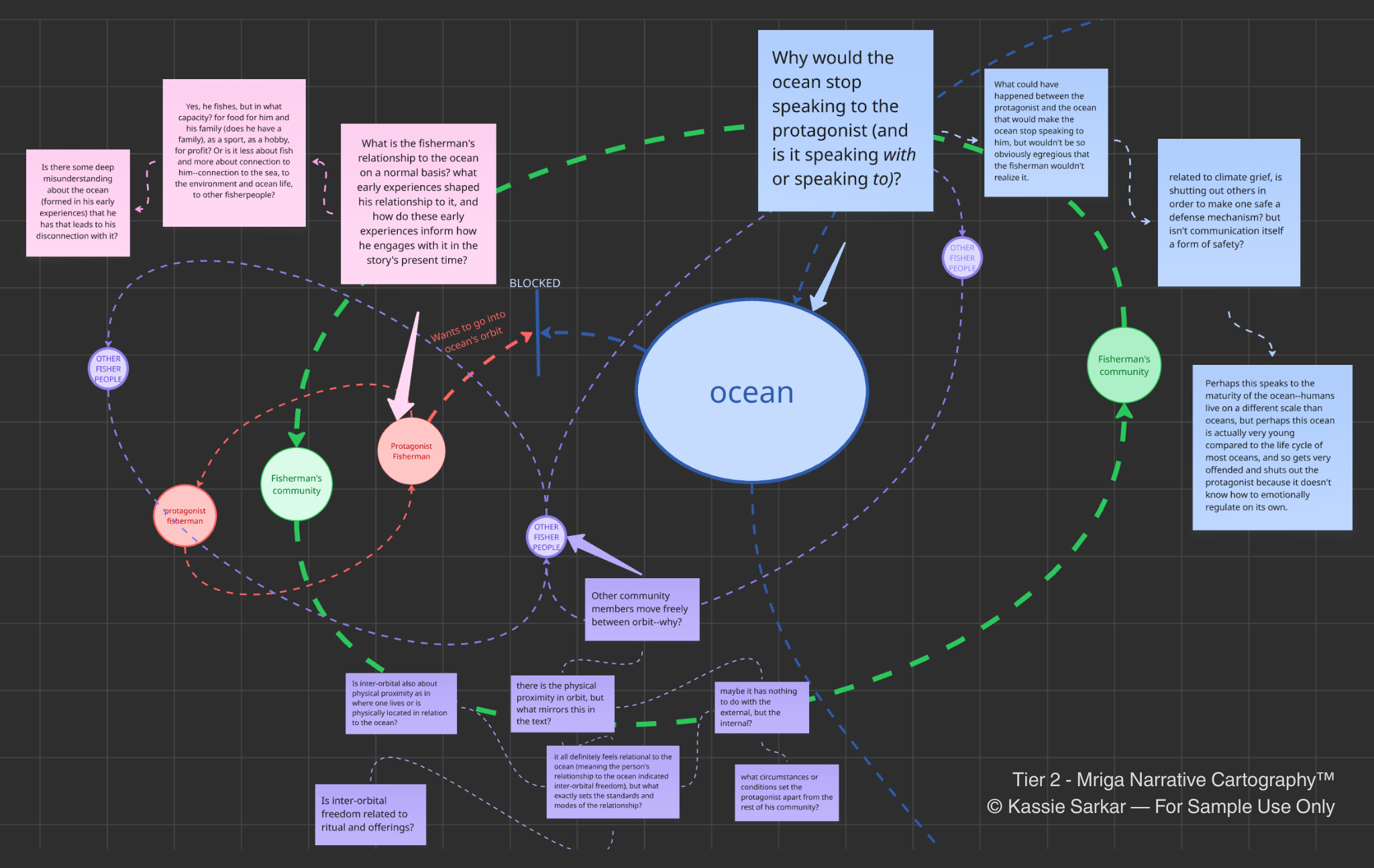
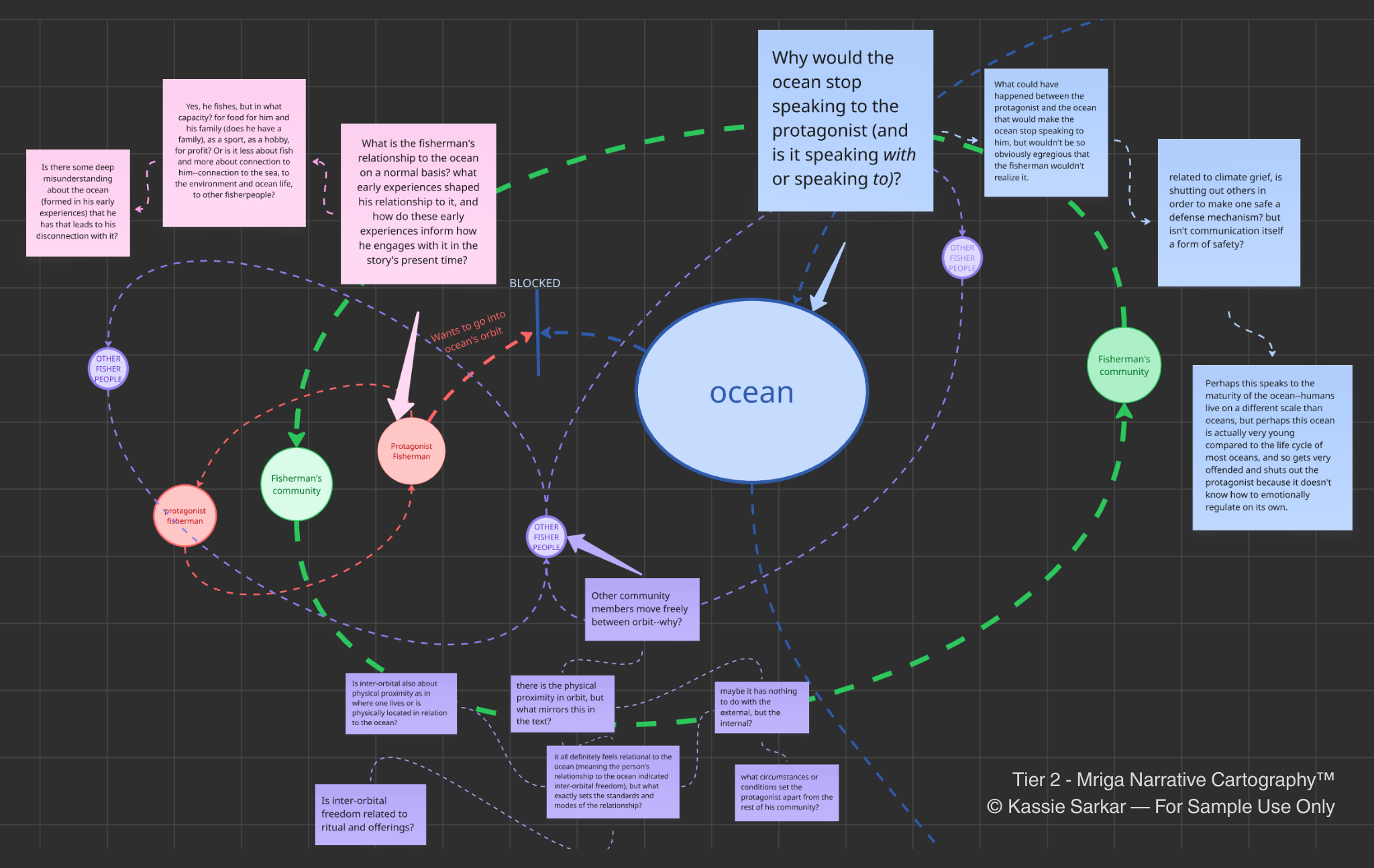
Tier 2 is where orbits, relational systems, and emotional movement become clear.
This is often the Tier where a story’s “shape” first emerges.
What Tier 2 might look like:
concentric or offset orbits
characters or forces exerting clear pulls
directional arrows showing who wants what
blocked pathways or tangled movement
clusters of thematic or relational questions
early internal segmentation (e.g., quadrants, inner layers)
mapping of systems (family, world, community, environment)
Tier 2 is where you first see:
tension
contradiction
gravitational imbalance
missing elements
the story’s emotional architecture beginning to reveal itself
Tier 2 is like entering the forest and noticing which paths are well-worn, blocked, or curving toward something unseen.
TIER 3 — DEEP ARCHITECTURE & ECOLOGY
“What invisible forces govern this world?”
Tier 3 is not “advanced.”
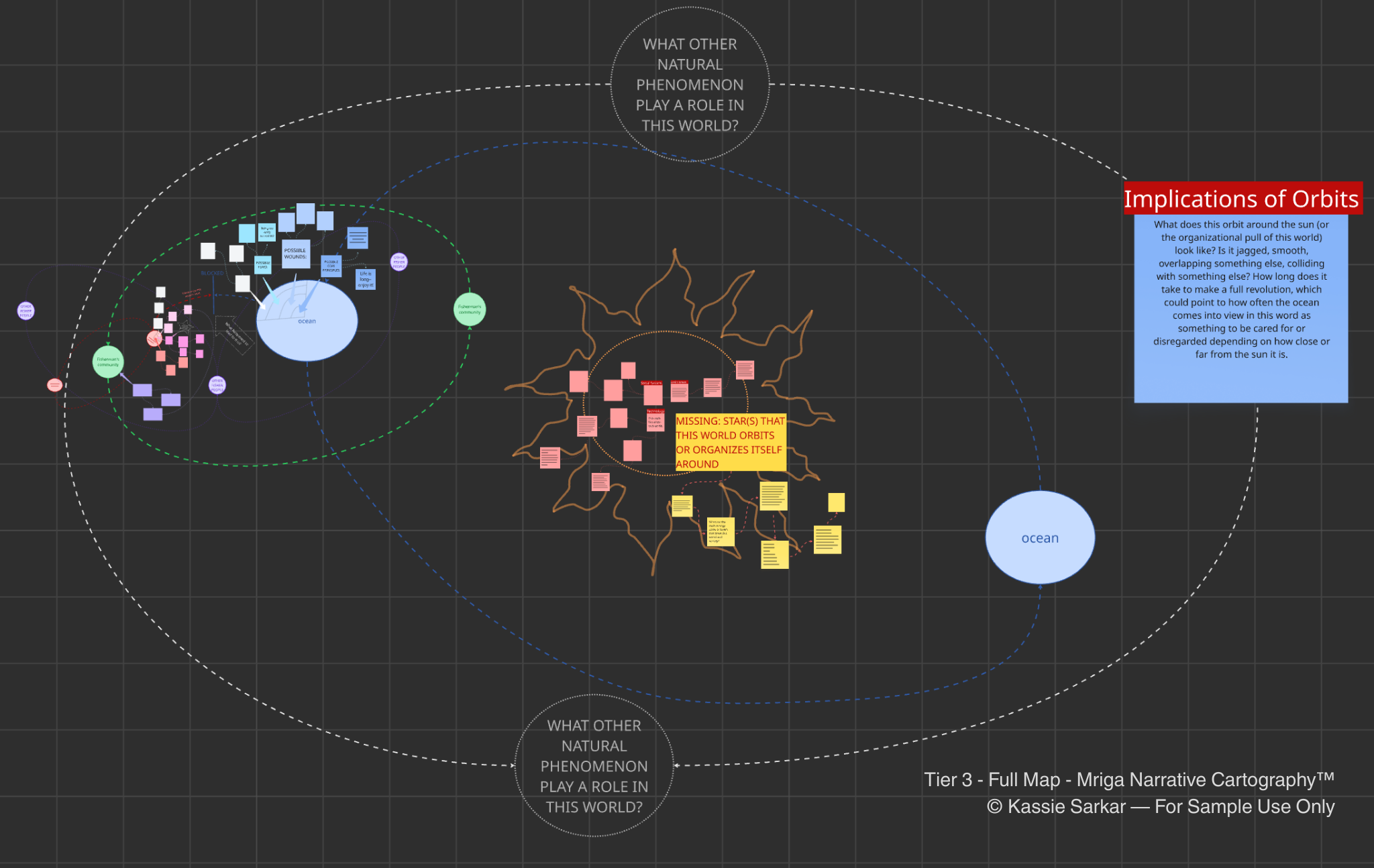
It is deep listening — mapping the emotional logic, symbolic architecture, and mythic/ecological forces that shape the story’s entire cosmos.
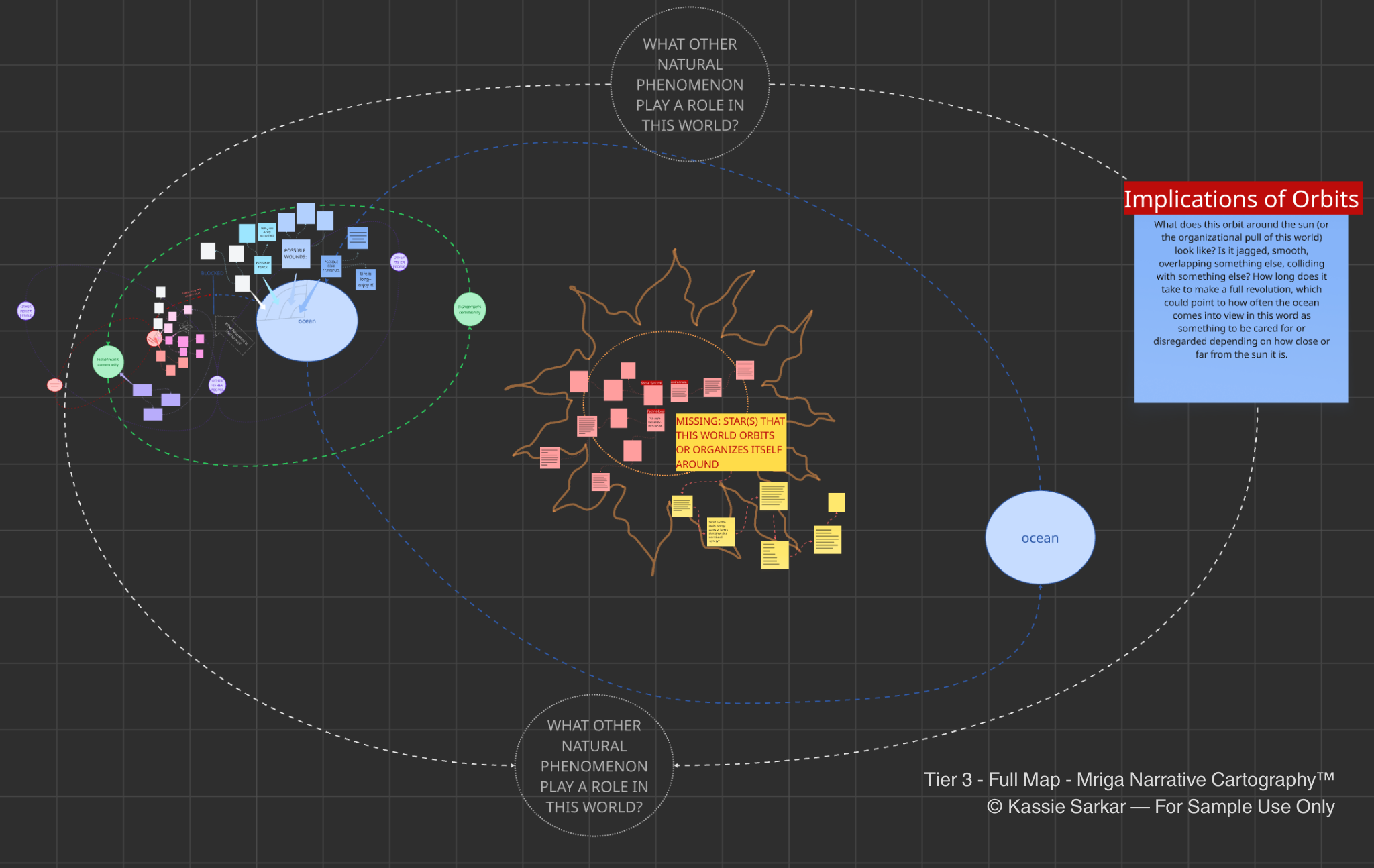
What Tier 3 might look like:
labeled internal structures inside characters or forces
identification of core tensions, wounds, or contradictions
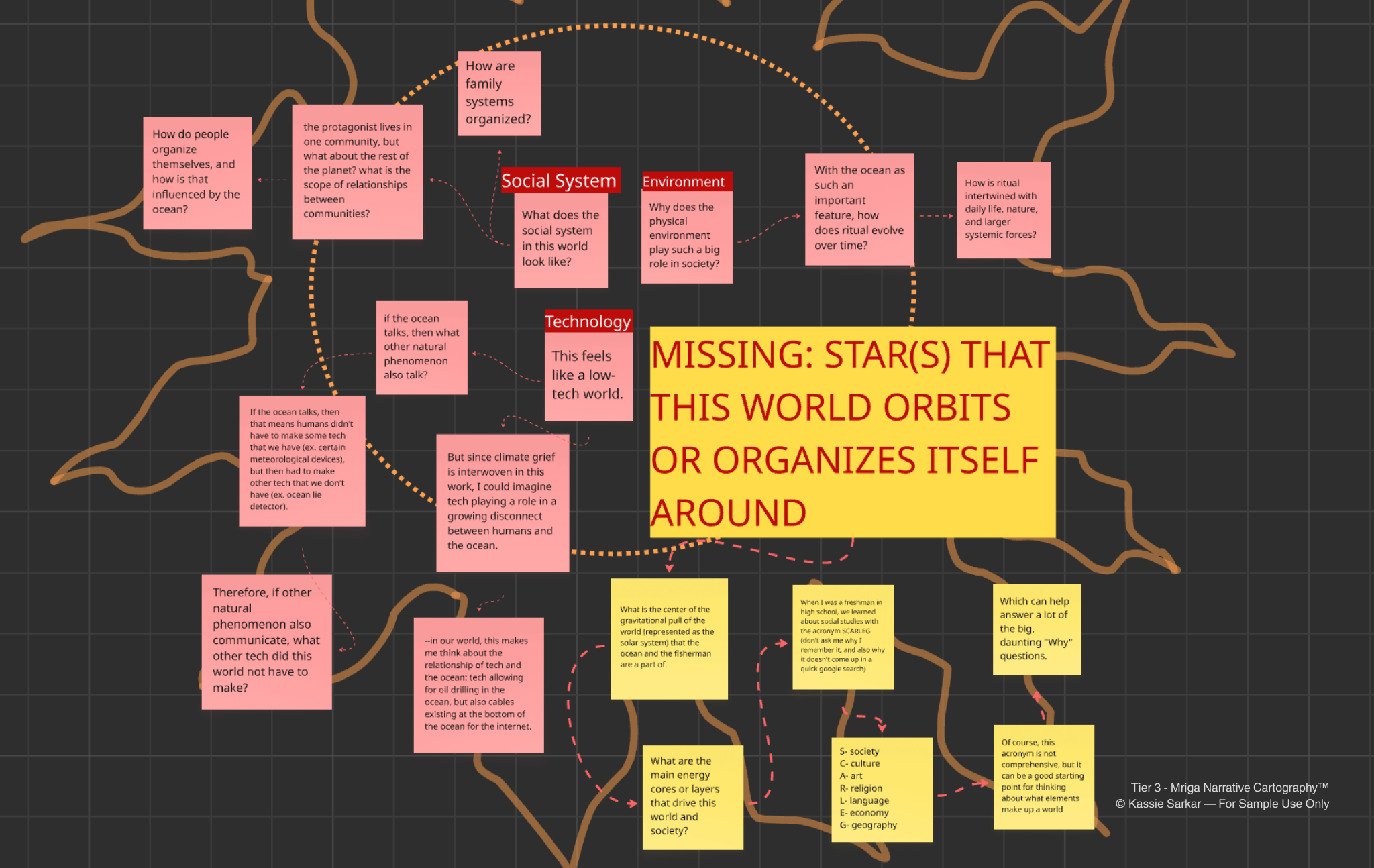
mapping of negative space (what’s missing, suppressed, or ghosted)
whole-system patterns (ecological, ritual, ancestral, ideological)
gravitational centers (explicit or absent)
symbolic or cosmological architectures
paradox mapping (“He longs for X but cannot bear what X requires”)
emotional or thematic weather (recurrence, cycles, storms)
Tier 3 asks:
What invisible architecture shapes this story?
What mythic or emotional system governs the characters?
What unresolved truth radiates through the narrative?
What is the story trying to become?
Tier 3 is like sensing not just the forest, but the climate, the soil memory, the patterns of migration, the ancestral weather.
A SINGLE STORY MAY SHOW MULTIPLE TIER BEHAVIORS
A map may begin in Tier 1 (“Who is here?”), move into Tier 2 (“What are the orbits?”), and dip briefly into Tier 3 (“What is the missing star this whole world orbits around?”).
This fluidity is a central feature of Mriga Narrative Cartography.
Ready to start?
Take a Closer Look at some Maps!
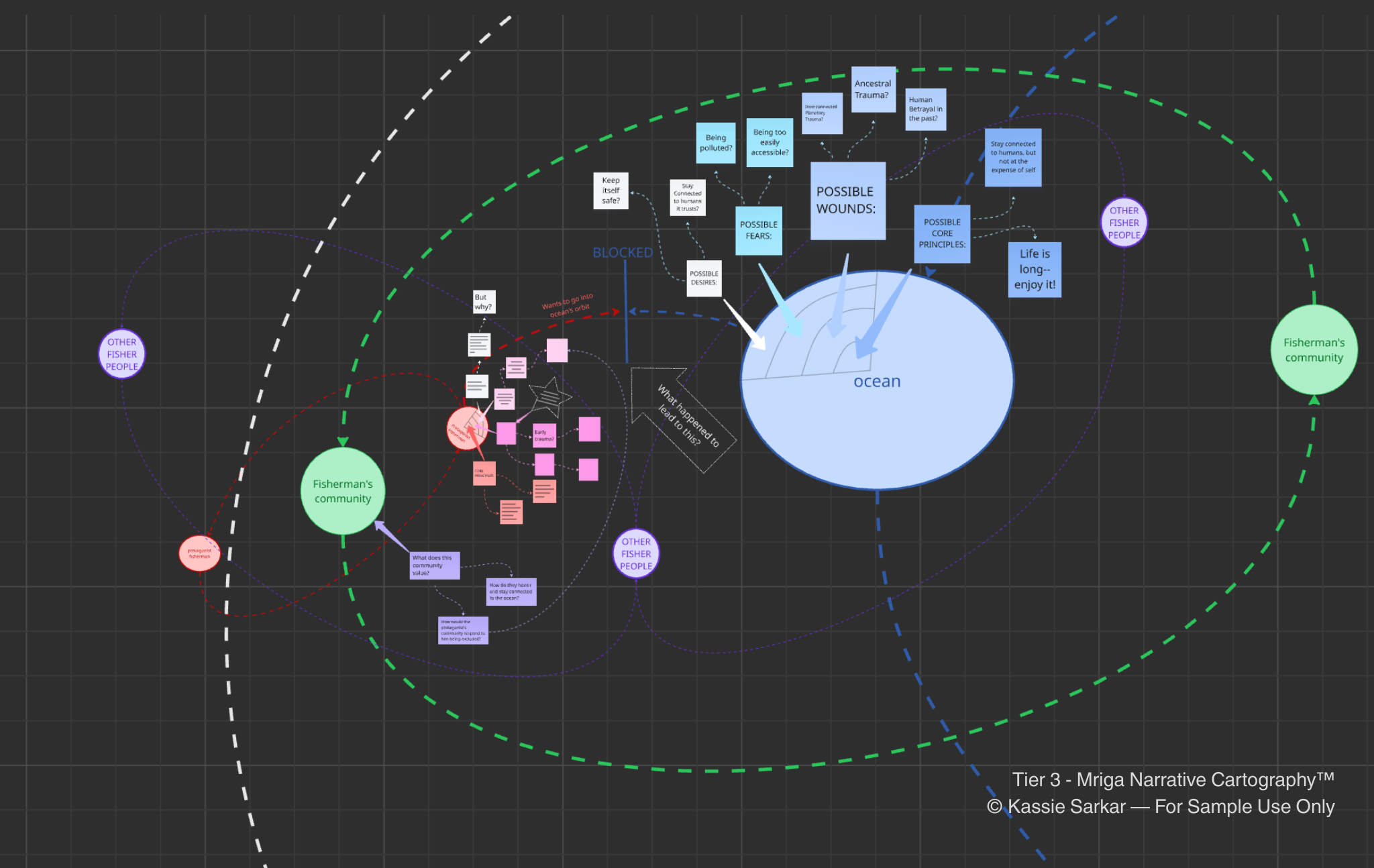
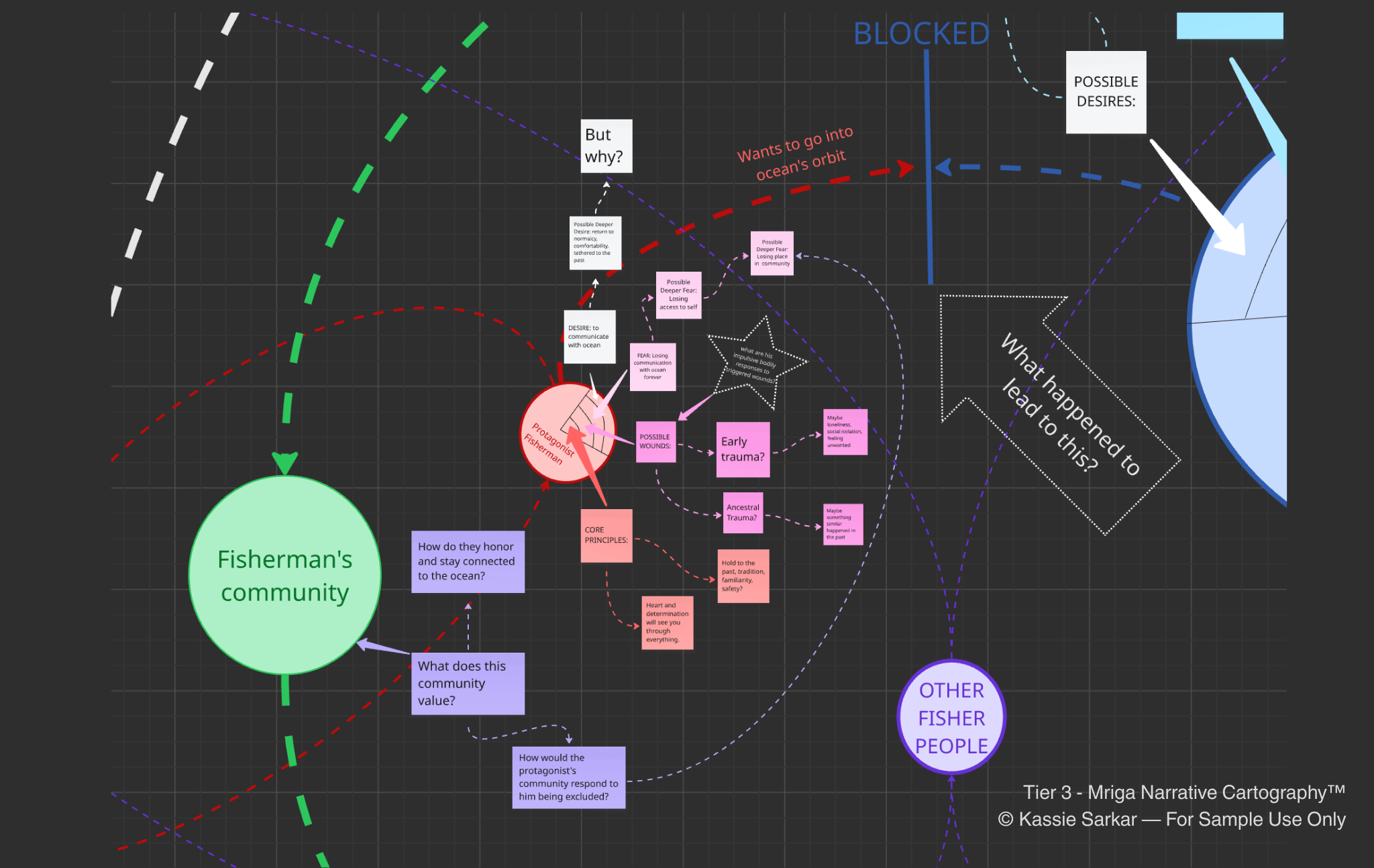
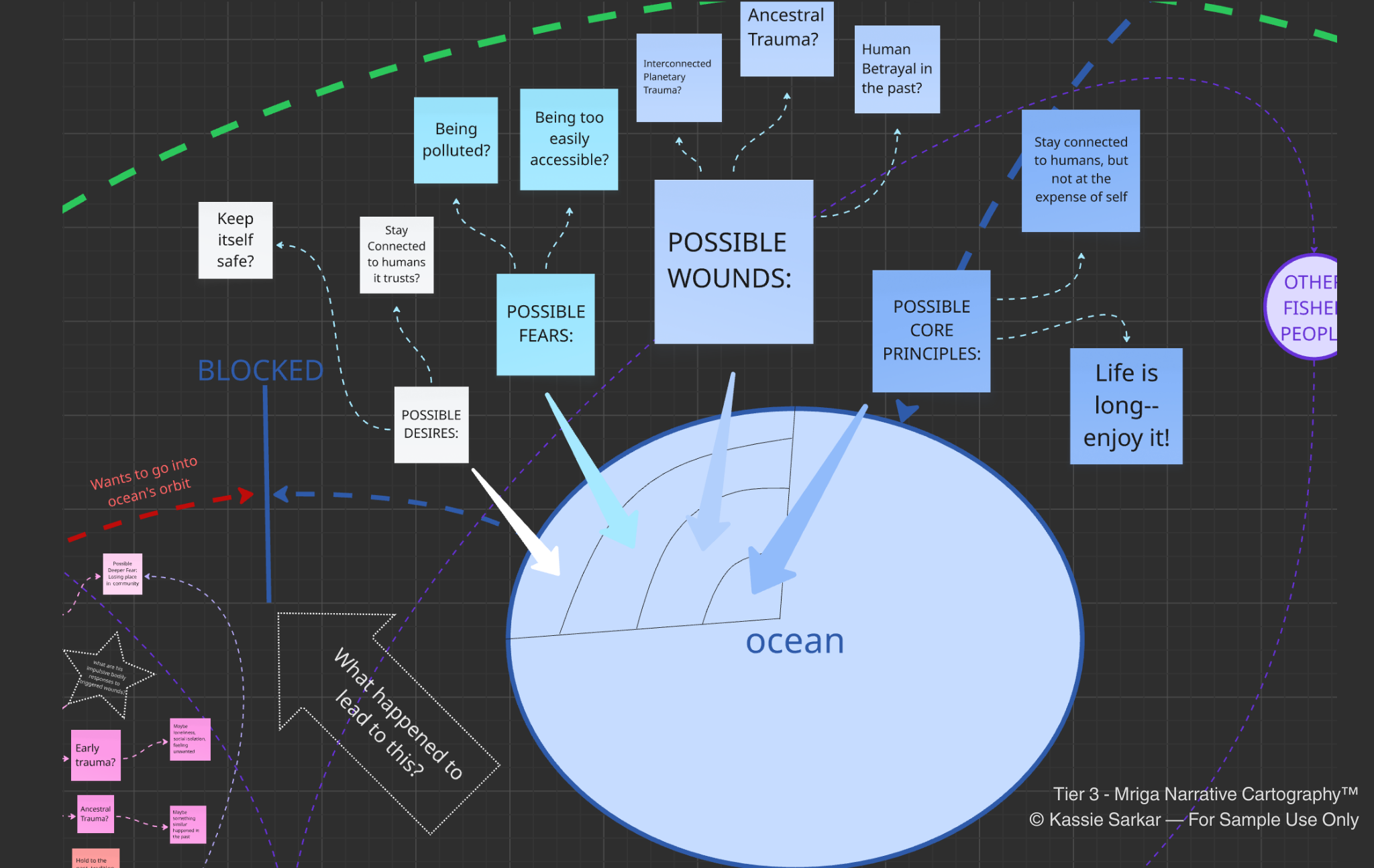
MINI TEXTUAL EXAMPLES
These are intentionally non-literal, symbolic sketches.
Example 1 — A fisherman and a silent ocean
Tier 1: circles labeled “Fisherman” and “Ocean,” placed near each other.
Tier 2: arrows showing he moves toward the ocean; ocean does not respond; community orbit lightly mapped.
Tier 3: inner structure of the fisherman labeled “dependence / dread / inheritance / longing”; ocean mapped as “silence-as-authority.” Missing gravitational center noted.
Example 2 — A girl who refuses a family tradition
Tier 1: bodies = girl, mother, tradition, community.
Tier 2: orbits show mother pulling inward, girl pushing outward; questions appear around obligation vs autonomy.
Tier 3: negative space reveals “What does she inherit?” and “What has been erased?”; tradition becomes a cosmological force.
Example 3 — A portal fantasy with unstable rules
Tier 1: bodies = protagonist, friend, portal, world.
Tier 2: arrows showing protagonist drawn inward; world repelling; portal movement blocked.
Tier 3: internal architecture labeled “fear of belonging,” “ambivalence around home”; world mapped as emotional ecosystem rather than geography.